

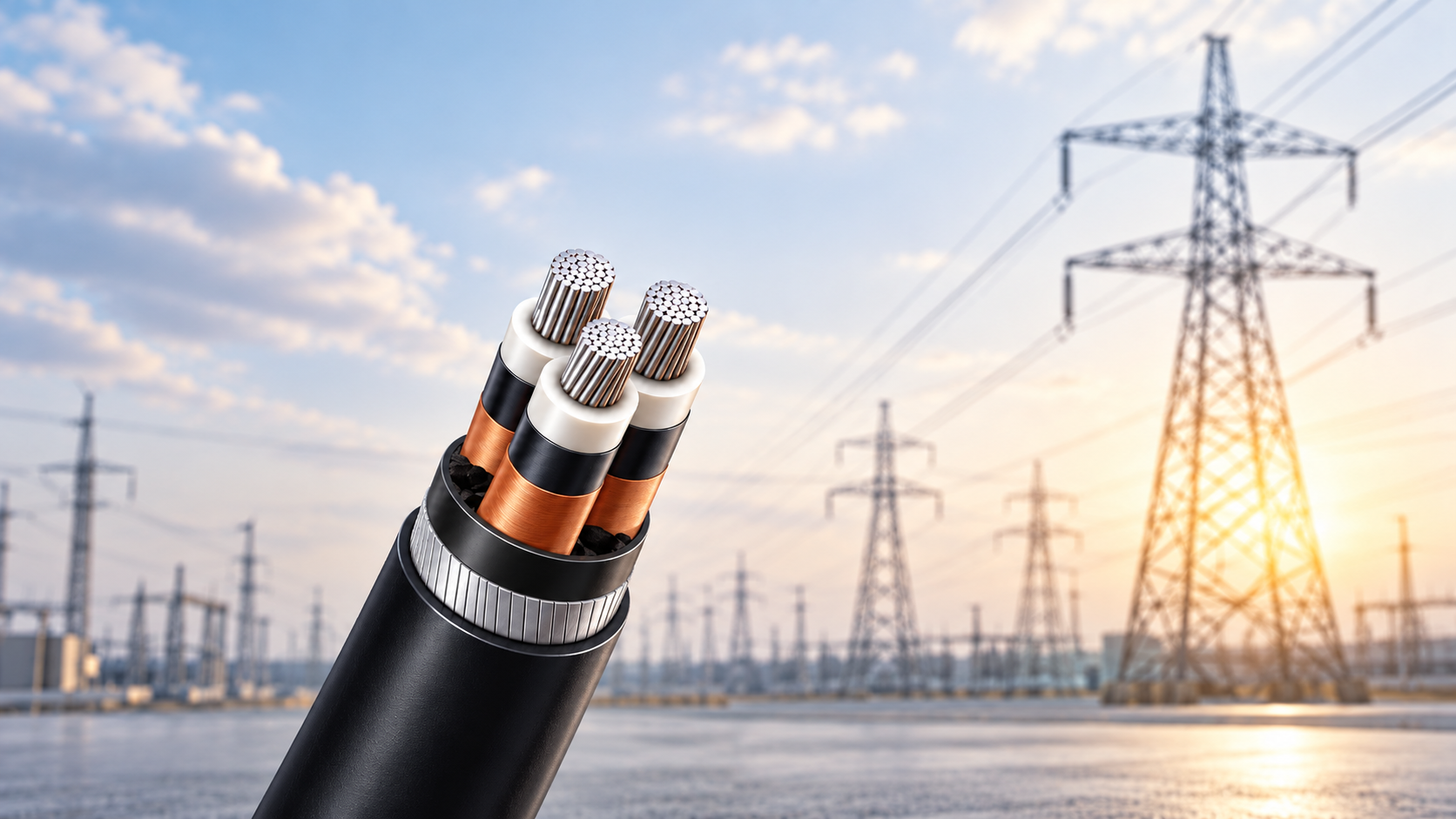
A solar park can generate power perfectly and still lose money if the 33 kV cable to the substation fails. The same risk applies to an industrial plant's 11 kV incomer or a city utility's underground ring main. Medium voltage cables sit at the heart of these networks, and they leave little room for error. That makes the choice of an HT XLPE cable manufacturer in India one of the most important calls in any distribution, industrial or renewable project.
This guide explains how an HT XLPE cable is built, what each layer does, which standards apply, and what engineers and buyers should check before they order. It draws on the published specifications of the Prem Cables HT XLPE range.
An HT XLPE cable is an underground or ducted power cable for medium voltage distribution. It uses cross-linked polyethylene (XLPE) insulation, semiconducting screens and armour to carry power safely at higher voltages than LT cables can handle.
The Prem Cables HT XLPE power cables range covers voltages up to 33 kV AC. These cables carry XLPE insulation, conductor and insulation screens, and armour for mechanical protection in demanding underground and industrial settings.
Keep the voltage boundary clear. LT cables serve circuits up to 1.1 kV, and Prem Cables offers LT XLPE power cables for that range. Once a circuit moves to 11 kV, 22 kV or 33 kV, the cable needs the screened construction that only an HT design provides.
An LT cable has a simple build: conductor, insulation, sheath and armour. An HT cable adds screens, because higher voltage creates stronger electrical stress inside the cable. Each extra layer controls that stress.
Prem Cables makes the conductor from aluminium or copper, in stranded or compacted form, with circular or sector shapes. The conductor follows IS 8130. Compacting the strands gives a smoother, rounder surface, which helps the screens sit evenly over it.
An extruded semiconducting layer covers the conductor. It smooths the electrical field at the conductor surface, so sharp points on the strands do not create stress peaks in the insulation.
The main insulation uses XLPE as per IS 7098 Part 2. XLPE gives high dielectric strength and low dielectric losses, which keeps energy waste down in long feeders. Prem Cables rates its HT XLPE cables for continuous operation from –15 °C to +90 °C, with short-circuit tolerance up to 250 °C.
A second extruded semiconducting layer sits over the insulation. A copper tape metallic screen goes on top where the design requires it. Together they keep the electrical field inside the insulation and give fault current a defined path to earth.
A PVC or PE inner sheath with a non-hygroscopic filler forms the bedding. The armour then goes on top. Multicore cables use GI strip or wire armour, while single core cables use aluminium wire armour. The armour protects the cable from crushing, ground movement and stress during installation.
The outer sheath comes in PVC-ST2, FR, FRLSH, PE and UV-stable options. FRLSH suits indoor routes where smoke and fire spread matter. UV-stable PE suits outdoor runs exposed to sunlight.
HT cables carry a two-part voltage grade, written as Uo/U. Uo is the voltage between the conductor and earth, and U is the voltage between two conductors. Prem Cables factory tests its range across grades from 1.9/3.3 kV up to 19/33 kV.
Selecting the right grade depends on the system voltage and on how the network handles earth faults. An earthed system and an unearthed system can need different grades for the same nominal voltage. Your design engineer should confirm the grade against the utility specification and IS 7098 Part 2 before you order.
Prem Cables lists four standards for its HT XLPE range:
Testing proves what the specification promises. Prem Cables states a high voltage test of 24 kV for 11 kV cables and 39 kV for 33 kV cables, each held for 5 minutes. The company also carries out partial discharge testing to check insulation integrity.
Partial discharge testing deserves special attention. Tiny voids or contamination inside the insulation can cause small electrical discharges that slowly damage the cable. A partial discharge test helps detect these flaws before the cable leaves the factory.
Prem Cables lists these applications for its HT XLPE range:
Underground HT cables suit routes where overhead lines cannot go, such as dense city areas, plant premises and substation yards. For overhead 11 kV to 33 kV feeders in tree-prone areas, utilities often choose a covered conductor instead. Our guide to MVCC cable specifications explains that option.
A strong buying decision starts with a clear specification and ends with test evidence. Use these checks to compare suppliers.
Fix the voltage grade and core count. Confirm the Uo/U grade, the number of cores and whether you need single core or multicore cables. This choice drives armour type and installation method.
Fix the conductor material and size. Decide between aluminium and copper, and match the size to load current, voltage drop and fault level. Current ratings depend on installation conditions, so your designer should apply the correct derating for burial depth, grouping and soil temperature.
Specify the screens and sheath. State whether you need a copper tape metallic screen, and choose the outer sheath for the location: FRLSH indoors, UV-stable PE outdoors, or standard PVC-ST2 for many buried runs.
Ask for test reports. Request routine test results, including the high voltage test and partial discharge test, for every drum in your order.
Check manufacturing control. Prem Cables runs ISO 9001:2015 certified processes and an in-house testing laboratory. It also produces its own aluminium wire rods on integrated production lines, which gives direct control over conductor material.
HT cables tolerate less rough handling than LT cables, because damage to the screens or insulation can cause a fault months later. Respect the minimum bending radius. Prem Cables specifies 15 times the overall cable diameter, and IS may allow 12 times in special cases.
Terminations and joints need equal care. Use kits matched to the cable's voltage grade, conductor size and screen design, and let trained jointers carry out the work. For broader site guidance on cable handling, read our post on LT power cable installation practices, much of which also applies to HT runs.
Prem Cables has manufactured aluminium conductors and cables since 1964, starting at Pipalia Kalan in Rajasthan. Its HT XLPE range builds on decades of conductor experience, combined with precision extrusion, robust screening and fire-safe sheath options.
For utilities, EPC contractors and renewable developers, this means a single manufacturer for conductors, LT cables, HT cables and covered conductors. That simplifies documentation and gives one point of accountability across a project.
HT XLPE cables carry the most critical feeders in a medium voltage network, so the specification must match the voltage grade, load, fault level and route. Buyers who confirm the Uo/U grade, conductor, screens, sheath and test reports avoid most supply and site problems.
When you compare an HT XLPE cable manufacturer in India, look for clear standards, documented high voltage and partial discharge testing, and control over raw material. Review the Prem Cables HT XLPE specifications, then contact the Prem Cables team to discuss voltage grades, sizes and technical documents for your next project.
An HT XLPE cable is a medium voltage power cable with cross-linked polyethylene insulation, semiconducting screens and armour, used for underground and industrial distribution up to 33 kV.
LT cables serve circuits up to 1.1 kV, while HT cables serve medium voltage circuits such as 11 kV, 22 kV and 33 kV and need conductor and insulation screens.
The first figure (Uo) is the voltage between conductor and earth, and the second (U) is the voltage between two conductors.
IS 7098 Part 2 is the primary Indian standard for XLPE insulated, screened cables up to 33 kV, and IS 8130 covers the conductors.
Prem Cables states a test voltage of 24 kV for 11 kV cables and 39 kV for 33 kV cables, each applied for 5 minutes.
Prem Cables specifies a minimum bending radius of 15 times the overall cable diameter, with 12 times allowed by IS in special cases.
Semiconducting screens smooth the electrical field at the conductor and insulation surfaces, which reduces stress points and protects the insulation.
Utilities, industries and renewable projects use HT XLPE cables for substation feeds, underground distribution, solar and wind power evacuation, and heavy industrial circuits.


