

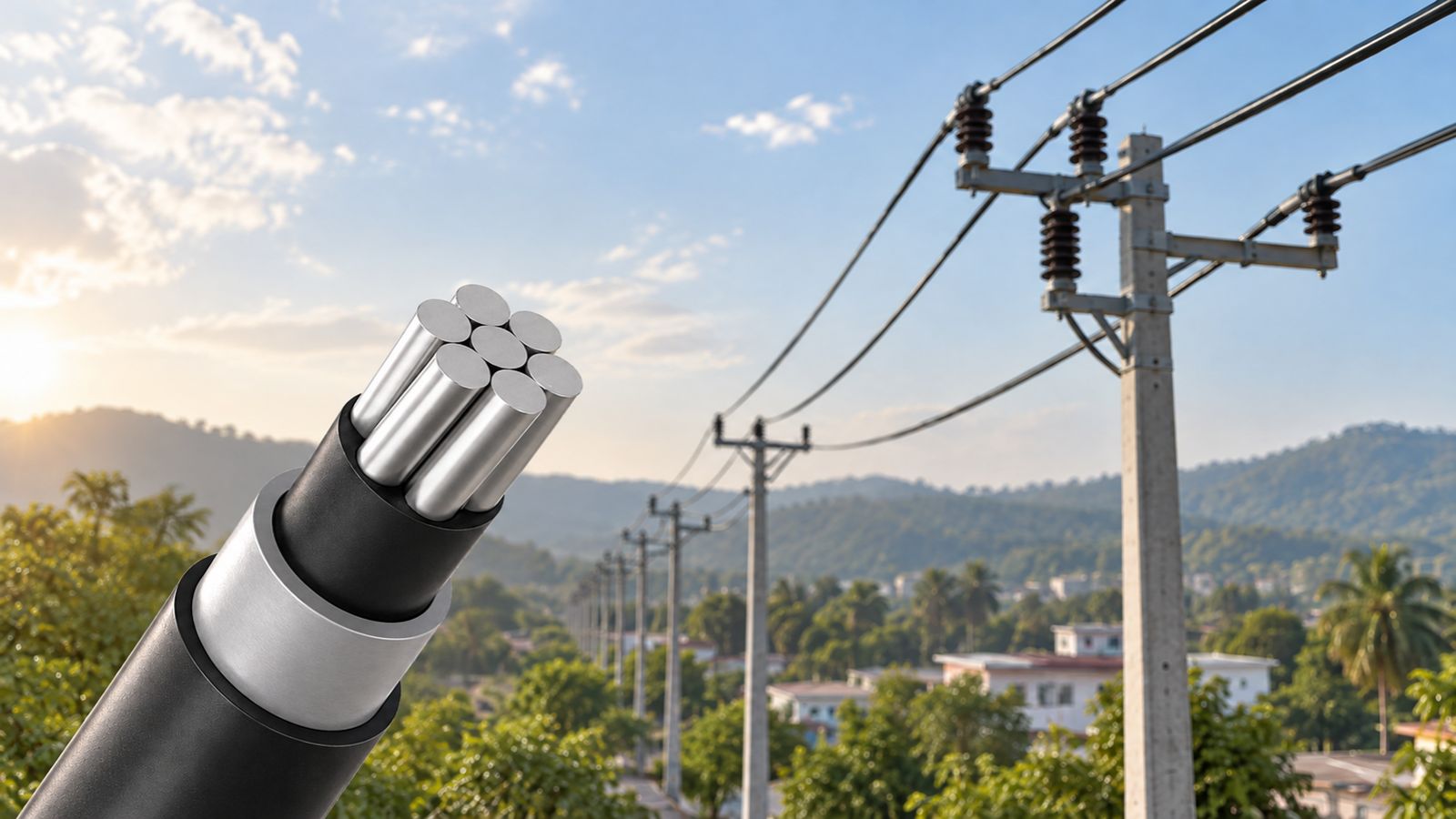
A utility tender for a 33 kV feeder through a forest belt often says "MVCC" in one line and leaves the rest to the bidders. That gap causes trouble later. Two suppliers can both quote for MVCC, yet one may offer a different conductor alloy, covering material or voltage class from the other. Reading MVCC cable specifications line by line is the only way to compare offers fairly and get a cable that suits the feeder.
This guide breaks an MVCC cable into its parts, explains what each specification line means, and lists the questions utilities, EPC contractors and importers should ask before they finalise an order.
A medium voltage covered conductor, or MVCC, is an overhead conductor with an extruded polymer covering. Utilities string it on poles like a bare conductor, but the covering protects the line when branches, birds or animals touch it.
The covering does not turn the line into a fully insulated cable. Utilities generally treat covered conductor lines like bare lines for safety clearances and live-line work. Crews should follow their own utility's safety rules on every MVCC network.
MVCC also differs from an LT AB cable. An AB cable serves low voltage networks up to 1.1 kV. The Prem Cables medium voltage covered cable range covers voltage ratings from 6.6 kV to 33 kV, with 11 kV, 22 kV and 33 kV as the common network classes.
A typical MVCC specification sheet lists the conductor, the water blocking layer, the insulation, the outer covering and the voltage rating. Each line answers a different engineering question.
The conductor carries current and most of the mechanical load. Prem Cables offers MVCC with AAAC, ACSR, AL7 or AL59 conductors.
Each option suits a different need. ACSR uses a galvanised steel core for strength on longer spans. AAAC and AL59 use all-alloy construction, which resists corrosion well in coastal and industrial areas. The Prem AL59 conductor offers about 59% IACS conductivity with good strength, which helps utilities reduce line losses.
Choose the conductor first, based on span length, load current and site environment. The covering then goes on top of that choice.
Prem Cables manufactures MVCC conductors from 31.60 sq.mm to 241 sq.mm, in single and multi-strand constructions. Size drives current capacity and resistance, so your designer should match it to the feeder's peak load and voltage drop limits. Larger sizes also add weight, so check pole strength and fitting ratings at the same time.
Prem Cables applies an extruded longitudinal water blocking layer over the conductor. This layer stops water from travelling along the strands if the covering gets damaged at one point. Without it, moisture can spread inside the conductor and cause corrosion far from the original damage.
Check that your specification asks for a water blocking layer, especially for coastal, high-rainfall or flood-prone routes.
Prem Cables uses MV and HT-grade XLPE for the insulation layer. The outer covering uses UV-resistant, tracking-resistant XLPE and HDPE.
Tracking resistance matters on overhead lines. Dust, salt and moisture can build up on the surface and create small leakage paths under voltage stress. A tracking-resistant covering reduces surface damage from these currents. UV resistance protects the covering from years of direct sunlight.
Prem Cables specifies a short-circuit maximum temperature of 250 °C for its MVCC. Your protection engineer should check this figure against the expected fault current and clearing time on the feeder. Ask the supplier to show where its test documents support this rating.
Standards for covered conductors work at two levels: the bare conductor inside, and the covered conductor as a whole.
For the conductor, use the standard that matches its type. IS 398 Part 4 covers aluminium alloy stranded conductors such as AAAC, and IEC 61089 covers round wire concentric lay overhead conductors.
For the complete covered conductor, EN 50397-1 sets requirements for covered conductors in overhead lines above 1 kV AC and up to 36 kV AC. It includes designs with integrated longitudinal water tightness. Prem Cables lists EN 50397-1 among its MVCC references and also manufactures utility specifications for 11 kV, 22 kV and 33 kV networks.
Many Indian utilities issue their own MVCC technical specifications. Always treat the utility document as the governing standard for the tender, and ask the manufacturer to confirm compliance clause by clause.
Prem Cables lists three main applications for its MVCC range:
The covering reduces faults from branches, tree contact, moisture and wildlife, including birds, monkeys and snakes. It also cuts phase-to-phase contact events when wind swings the conductors together. For a closer look at how this lowers outages, read our post on how MVCC cables help utilities cut line tripping.
MVCC is not the right answer for every feeder. A clear rural route with no trees and few faults may run well on bare conductors at a lower cost. Utilities should compare the full life cost, including outage hours, tree trimming and maintenance, before choosing.
Most problems with MVCC orders start on paper, long before the cable reaches the site. Four mistakes come up again and again.
Leaving the conductor type open. A tender that says only "MVCC, 33 kV" lets bidders offer different conductors. One bid may use ACSR while another uses AAAC, and the prices will not compare fairly.
Skipping the water blocking layer. Some buyers drop this layer to save cost. On a wet or coastal route, that choice can shorten conductor life if the covering ever gets cut.
Ignoring the fault level. The short-circuit rating must suit the feeder's protection settings. A mismatch can damage the covering during a fault.
Forgetting accessories. MVCC needs clamps, joints and terminations designed for covered conductors. Plan these with the cable order so the line goes up without delays.
Before you sign a purchase order, run through these points with your supplier:
A clear checklist protects both sides. It also makes bids from different manufacturers easy to compare on equal terms.
Prem Cables has manufactured aluminium conductors since 1964 at Pipalia Kalan in Rajasthan. Its MVCC builds on that conductor experience, using AAAC, ACSR, AL7 and AL59 cores that the company also offers as bare conductors.
The company produces its own aluminium wire rods, including AL-7 and AL-59 alloy grades, on integrated production lines. It runs ISO 9001:2015 certified processes and an in-house testing laboratory. For utilities and EPC contractors, this gives one accountable manufacturer from raw rod to finished covered conductor.
MVCC can cut outages and improve safety on 11 kV to 33 kV overhead lines, but only when the specification matches the route, the load and the fault level. Buyers who check the conductor type, water blocking, covering material, short-circuit rating and governing standards avoid most supply and site problems.
Review the full MVCC cable specifications on the Prem Cables product page, then contact the Prem Cables team to discuss conductor options, sizes and technical documents for your next distribution project.
MVCC stands for medium voltage covered conductor. It is an overhead conductor with an extruded XLPE or HDPE covering that reduces faults when trees, birds or animals touch the line.
Prem Cables manufactures MVCC for voltage ratings from 6.6 kV to 33 kV, mainly for 11 kV, 22 kV and 33 kV distribution networks.
AB cable serves low voltage networks up to 1.1 kV, while MVCC serves medium voltage overhead lines up to 33 kV.
No. The covering reduces faults from brief contact, but utilities generally treat covered conductor lines like bare lines for safety clearances and live-line work.
Prem Cables offers MVCC with AAAC, ACSR, AL7 or AL59 conductors, chosen by span length, load and site environment.
EN 50397-1 covers covered conductors for overhead lines above 1 kV and up to 36 kV, and many Indian utilities also issue their own MVCC technical specifications.
The longitudinal water blocking layer stops moisture from travelling along the conductor strands if the covering gets damaged.
Prem Cables manufactures MVCC conductors from 31.60 sq.mm to 241 sq.mm in single and multi-strand constructions.


