

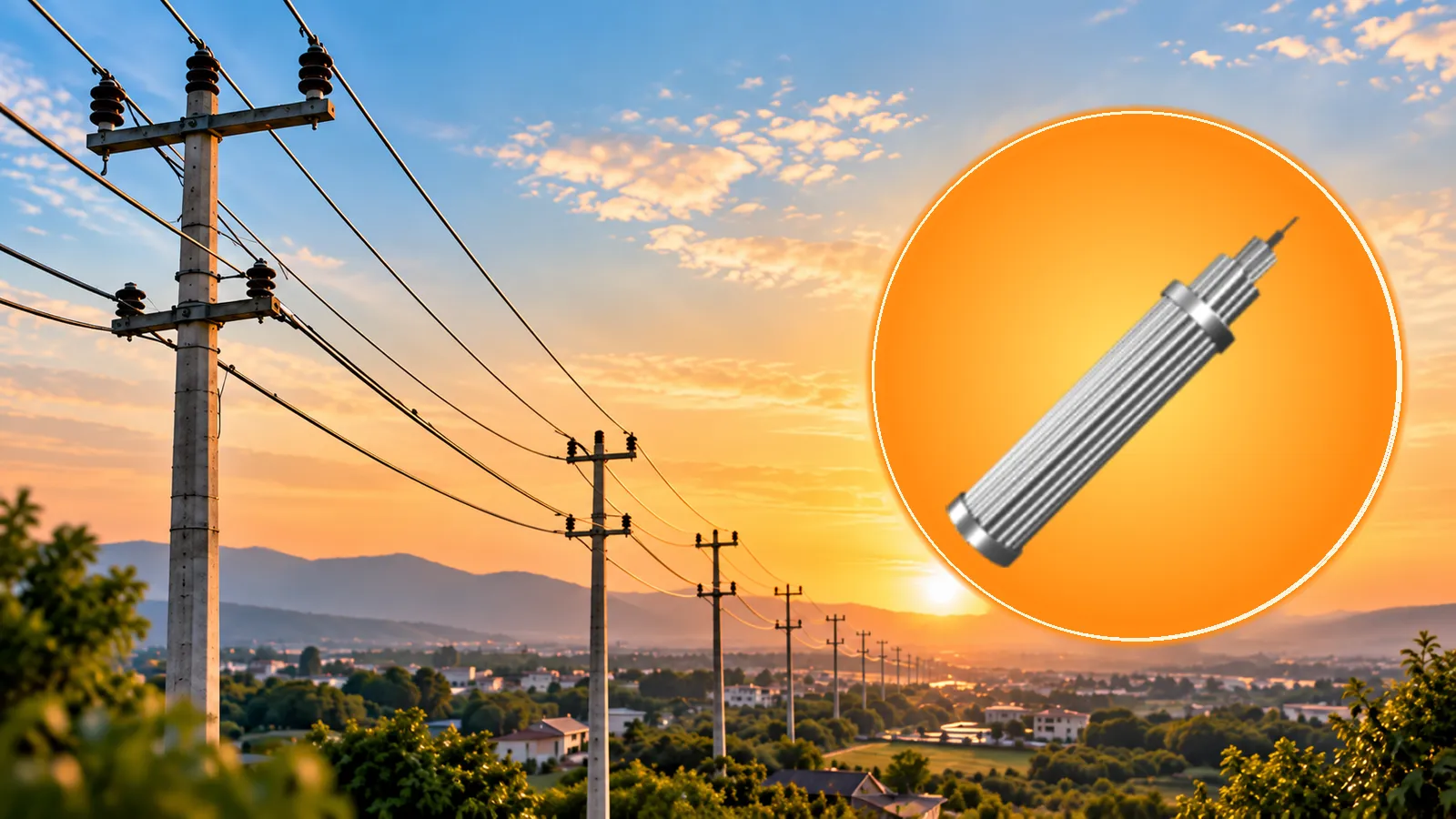
A distribution engineer planning a new village feeder or a town's overhead network needs a conductor that carries current well, weighs little and survives years of sun, rain and pollution. For many of these lines, the answer is an AAC conductor. It is one of the simplest overhead conductors in use, yet buyers still need to understand its construction, sizes and limits to specify it correctly.
This guide explains what an AAC conductor is, how it is built, how to read its size designations, where it performs best and what to check before ordering. It draws on the published specifications of the Prem Cables AAC range.
AAC stands for All Aluminium Conductor. As the name says, every strand is aluminium. There is no alloy and no reinforcing core, so the conductor's strength and conductivity both come from the aluminium wires alone.
Prem Cables designs its AAC conductors for low and medium voltage overhead distribution. The company manufactures them from hard-drawn aluminium wires, stranded for good conductivity and mechanical performance.
Prem Cables uses EC grade aluminium, 1350-H19, as per IS 398 Part 1. EC stands for electrical conductor grade, which means high-purity aluminium chosen for its conductivity. The H19 temper means the wires are fully hard after drawing, which gives them the strength needed for overhead spans.
The conductor delivers a minimum conductivity of 61% IACS. That high conductivity keeps resistance low, which helps reduce losses along the line.
Prem Cables strands its AAC conductors in a concentric lay of circular wires. The manufacturer winds layers of wires around a central wire, with each layer laid in a helix.
Available stranding options are 7, 19, 37 and 61 wires, depending on conductor size. A larger conductor uses more strands, which keeps it flexible enough to handle and string despite its greater cross-section.
The finished conductor has a smooth, bright aluminium surface. A smooth surface helps the conductor shed water and resist corrosion, and it allows clamps and joints to seat properly.
AAC sizes often appear as two numbers joined by a slash, such as 7/3.35 mm. The first number gives the count of strands, and the second gives the diameter of each strand in millimetres. So 7/3.35 mm means seven aluminium wires, each 3.35 mm thick.
Prem Cables lists example sizes of 7/1.35 mm, 7/1.50 mm and 7/3.35 mm, along with 19-wire variants. Larger sizes move to 37 and 61-wire constructions.
Two other values matter when you select a size. DC resistance follows the values set in IS 398 Part 1, and the tensile strength of the conductor depends on the ultimate tensile strength of the aluminium wires multiplied by the stranding efficiency. Your line designer uses both figures to check current capacity, voltage drop, sag and tension for each span.
With 61% IACS minimum conductivity, AAC carries current efficiently. Lower resistance means lower heating and lower energy losses on the line. Our article on how aluminium conductors reduce transmission line losses explains this link in more detail.
Aluminium is light, so AAC reduces the load on poles and towers. Lighter conductors also make overhead line design more cost-effective, because the supporting structures can be simpler.
The all-aluminium construction resists atmospheric, coastal and industrial corrosion. Aluminium forms a thin natural oxide layer on its surface, which protects the metal underneath. AAC is also non-magnetic, and Prem Cables highlights its long-term reliability with minimal maintenance.
Light weight and flexible stranding make AAC quick to string and simple to joint. Crews need less heavy equipment, which reduces installation cost and time.
Prem Cables lists these applications for its AAC range:
AAC fits short and moderate spans best. Because it relies on pure aluminium for strength, very long spans or heavy mechanical loads need careful design checks. For typical distribution layouts in towns and villages, though, AAC offers a practical balance of conductivity, weight and cost.
Rural networks form one of its most common uses. For more on that role, read our post on how aluminium conductors support India's rural electrification push.
Prem Cables rates its AAC conductors for continuous operation from –10 °C to +75 °C. Designers should keep the conductor within this range under normal load, allowing for sun, ambient temperature and wind conditions on the route.
The conductor suits standard clamps, joints and tension fittings. Choose fittings rated for the conductor size and design tension, and make sure crews clean and prepare contact surfaces before they install joints. Good jointing practice prevents hot spots and early failures.
Prem Cables manufactures its AAC range to these standards:
For Indian utility tenders, IS 398 Part 1 usually governs. Export projects may call for ASTM, BS or IEC references instead. Name the exact standard in your purchase order. Our guide to aluminium conductor manufacturing standards explains how buyers can use these standards during procurement.
A few errors appear often in AAC tenders and site work.
Writing only the cross-section. A tender that states only an area, without stranding, leaves room for different constructions. Always state the full designation, such as 7/3.35 mm.
Skipping the sag check. AAC suits short and moderate spans, but a span that runs longer than planned can sag beyond safe clearance in summer heat. Check sag at the maximum operating temperature for every span.
Mixing fittings. Clamps and joints sized for a different conductor may not grip correctly. Loose fittings heat up under load and can fail early.
Rough handling at site. Dragging the conductor over the ground scratches the strands and damages the smooth surface. Use rollers and keep drums upright during transport.
A short checklist helps buyers avoid supply and site problems:
Clear specifications make bids easy to compare and reduce the risk of receiving a conductor that does not suit the line.
Prem Cables has manufactured aluminium conductors since 1964, starting at Pipalia Kalan in Rajasthan. Its AAC range builds on that long experience with overhead conductors for utilities and infrastructure projects.
The company runs ISO 9001:2015 certified processes and an in-house testing laboratory, and it manufactures in compliance with IS, BS, IEC and ASTM standards. For utilities, EPC contractors and international buyers, that means documented quality and consistent conductors across large orders.
An AAC conductor offers high conductivity, light weight and good corrosion resistance, which makes it a reliable choice for short and medium span distribution lines in urban, rural, coastal and industrial areas. Buyers who confirm size, stranding, resistance and standards before ordering get a conductor that performs as designed for years.
Explore the full Prem Cables AAC range, then contact the Prem Cables team to discuss sizes, stranding and technical documents for your next distribution project.
AAC stands for All Aluminium Conductor. It is an overhead conductor made entirely of hard-drawn aluminium strands, used mainly for distribution lines.
AAC stands for All Aluminium Conductor.
AAC conductors serve overhead distribution lines in urban and rural networks, short to medium span LT and HT circuits, and coastal or industrial areas.
It means the conductor has 7 aluminium strands, each with a diameter of 3.35 mm.
Prem Cables AAC conductors deliver a minimum conductivity of 61% IACS, using EC grade 1350-H19 aluminium.
IS 398 Part 1 is the Indian standard for hard-drawn aluminium stranded conductors, including AAC.
Prem Cables rates its AAC conductors for continuous operation from –10 °C to +75 °C.
Yes. Its all-aluminium construction resists atmospheric, coastal and industrial corrosion.


