

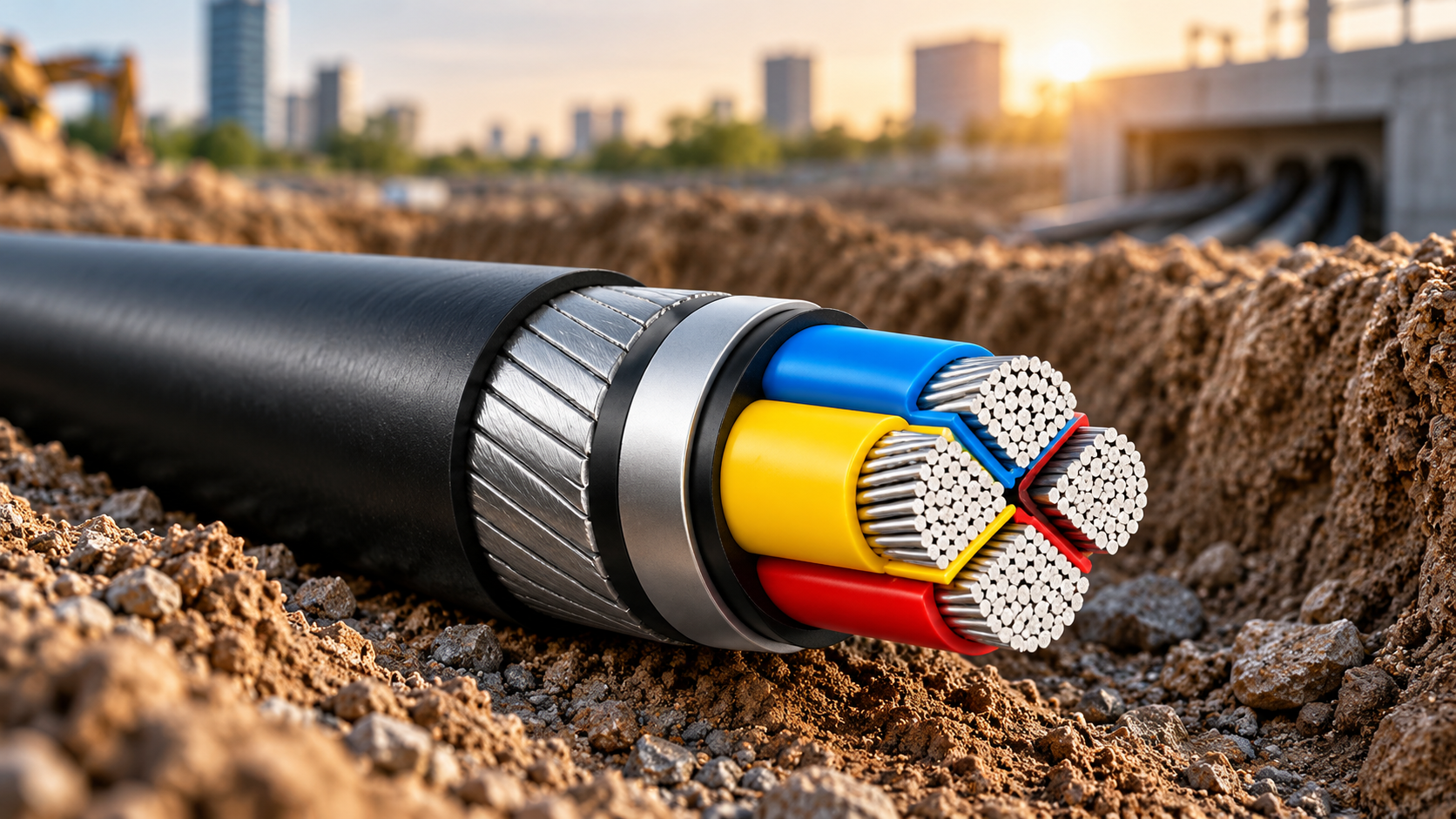
Every LT cable schedule forces one early decision: PVC or XLPE insulation. The two cables can look almost identical on a drum, carry the same 1.1 kV rating and fit the same trench. Yet they behave differently under heat, overload and fault conditions, and they cost different amounts. Understanding PVC vs XLPE cable performance helps engineers and buyers pick the right option for each circuit instead of defaulting to one type everywhere.
This guide compares the two insulation types on construction, temperature limits, sizes, standards and cost. It uses the published specifications of the Prem Cables PVC LT and LT XLPE ranges.
PVC (polyvinyl chloride) is a thermoplastic. It softens as it heats up, which sets a lower ceiling on its working temperature. Cable makers have used PVC for decades because it is economical, easy to process and reliable within its limits.
XLPE (cross-linked polyethylene) starts as polyethylene, then goes through a cross-linking process that bonds its molecular chains together. This change stops the material from softening the way a thermoplastic does. As a result, XLPE handles higher temperatures and holds its shape better under heat.
Both materials make good insulation for low voltage underground cables. The right choice depends on the load, the installation and the budget.
Prem Cables manufactures PVC LT underground cables for low voltage power distribution up to 1.1 kV. Key specifications from the Prem Cables range include:
These ratings depend on the installation method, so treat them as typical values rather than fixed limits.
Prem Cables also manufactures LT XLPE power cables for the same 1.1 kV range. Key specifications include:
Again, actual ratings change with installation conditions.
Put the two ranges side by side and five differences stand out.
PVC cables run up to 70 °C continuously. XLPE cables run up to 90 °C continuously and handle 120 °C during overload. That extra headroom lets an XLPE cable carry more current for the same conductor size, or cope better with hot ambient conditions.
During a fault, PVC insulation tolerates up to 160 °C. XLPE tolerates 250 °C to 280 °C. Higher short-circuit tolerance gives the protection system more margin to clear a fault before the insulation suffers damage.
The Prem PVC LT range goes up to 500 sq.mm, while the LT XLPE range extends up to 1000 sq.mm. Very large feeders, such as main incomers in big plants, often need the larger XLPE sizes.
Both ranges offer flame-retardant sheaths. The XLPE range adds FRLS (Flame Retardant Low Smoke) and LSZH (Low Smoke Zero Halogen) options, which suit enclosed spaces such as basements, shafts and tunnels where smoke matters.
PVC cables usually cost less than XLPE cables of the same size. For circuits with moderate loads and simple duty, that saving can be worth taking. Prem Cables describes its PVC range as an optimised design for economical low voltage networks without compromising durability.
PVC cables remain a smart choice for many everyday circuits. Prem Cables lists these applications for its PVC LT range:
PVC suits circuits where the load stays well within the cable rating, the ambient temperature stays moderate, and budget pressure is high. Many residential and small commercial projects fall into this group.
XLPE earns its higher cost on demanding circuits. Prem Cables lists high-load circuits in manufacturing plants, data centres and high-rise buildings among its LT XLPE applications, along with the replacement of ageing duct-bank networks.
Choose XLPE when a feeder runs near full load for long hours, when the route passes through hot areas, or when the fault level is high. It also makes sense when you need large conductor sizes or low-smoke sheaths. For a project-level example, read our guide to 4 core armoured LT XLPE cables for Delhi NCR projects.
Each insulation type follows its own primary Indian standard.
Name the correct standard in your purchase order, and ask the manufacturer for test certificates against it. A cable built to IS 1554 Part 1 is a PVC cable, so a specification that mixes the two standards needs correcting before tender.
Work through these questions for each circuit before you choose:
If most answers point to heavy load, heat, high fault level or enclosed spaces, XLPE is the stronger fit. If the circuit is light, cool and cost-sensitive, PVC often does the job well.
Both PVC and XLPE LT cables need a minimum bending radius of 12 times the overall cable diameter in the Prem ranges. Plan trench corners and tray bends around this figure.
Pull cables over rollers, protect the outer sheath during laying, and seal cable ends until termination. These simple steps prevent moisture entry and sheath damage. For a fuller site checklist, see our post on LT power cable installation practices.
Prem Cables has manufactured aluminium conductors and cables since 1964, starting at Pipalia Kalan in Rajasthan. It offers both PVC and XLPE LT cables, so buyers can source both types from one manufacturer and match each circuit to the right insulation.
The company runs ISO 9001:2015 certified processes and an in-house testing laboratory. It also produces its own aluminium wire rods on integrated production lines, which gives direct control over conductor quality.
The PVC vs XLPE cable choice comes down to load, temperature, fault level, size and budget. PVC offers proven, economical performance for moderate circuits, while XLPE gives more thermal headroom, higher short-circuit tolerance and larger sizes for demanding feeders. Many projects use both, each where it fits best.
Compare the Prem Cables PVC LT and LT XLPE specifications, then contact the Prem Cables team to discuss sizes, insulation options and technical documents for your next project.
PVC is a thermoplastic insulation rated for 70 °C continuous operation, while XLPE is cross-linked and rated for 90 °C continuous, with higher overload and short-circuit limits.
Neither is better for every circuit. XLPE suits heavy loads, hot routes and high fault levels, while PVC suits moderate, cost-sensitive circuits.
Prem Cables rates its PVC LT cables for –15 °C to +70 °C in operation and up to 160 °C during a short circuit.
Prem Cables rates its LT XLPE cables for 90 °C continuous, 120 °C overload and 250 °C to 280 °C during a short circuit.
IS 1554 Part 1 covers PVC insulated cables up to 1.1 kV, while IS 7098 Part 1 covers XLPE insulated cables up to 1.1 kV.
Yes, XLPE cables usually cost more than PVC cables of the same size, which is why PVC remains popular for moderate loads.
Yes. Armoured PVC LT cables suit direct burial, cable trenches and duct banks for low voltage distribution up to 1.1 kV.
Prem Cables offers PVC LT cables from 4 sq.mm to 500 sq.mm, with overall diameters from 10.5 mm to 74 mm.


