
.png)
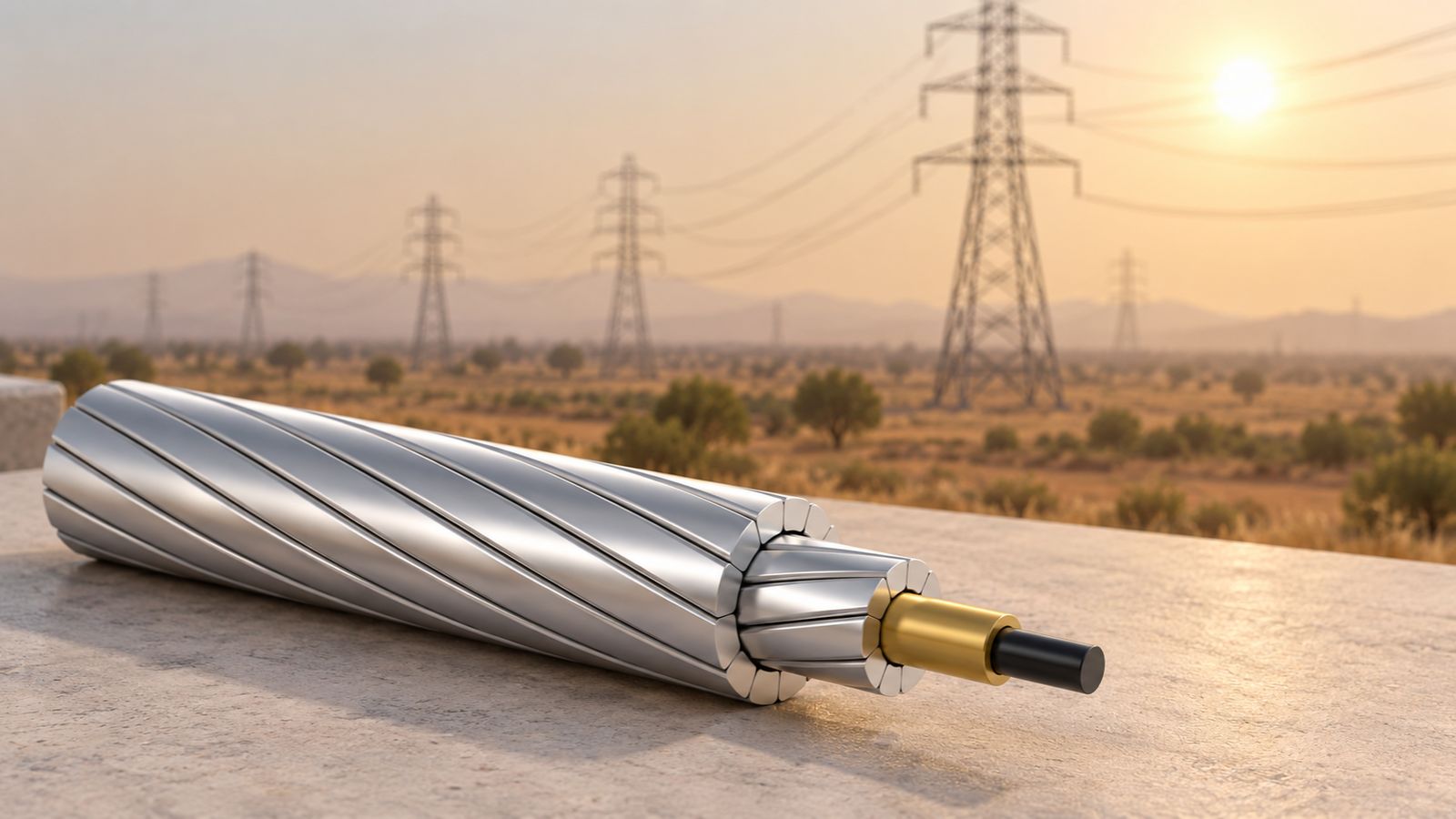
On a still afternoon in a Rajasthan summer, the air around a transmission line can climb well past 45 °C. The conductor starts the day hot, the sun heats it further and the load keeps rising as cooling demand peaks. Conventional conductors struggle in these hours because heat pushes them towards their temperature limit and makes them sag. HTLS conductors exist for exactly this situation. This article explains how heat affects an overhead conductor and how HTLS designs from Prem Cables handle high ambient temperatures.
Every overhead conductor has a maximum temperature it can safely reach. Two things push its temperature up. One is the heat from the current it carries. The other is heat from its surroundings, including the sun and the air.
When the surrounding air is already hot, the conductor starts closer to its limit. It has less room left for heating from current. So on the hottest days, the line can safely carry less power, even though the grid needs more.
Heat also changes the shape of the line. Metal expands as it warms. A longer conductor between the same two towers hangs lower. Prem Cables notes that standard ACSR conductors experience increased sag as they heat up. Too much sag can bring a line below its safe clearance.
Prem Cables states that standard ACSR conductors reach their thermal limit at around 75 °C to 90 °C. Its data for hard-drawn 1350 aluminium, the material in ACSR, lists 80 °C for continuous operation. The emergency limit is 120 °C.
Now picture a summer day with the air at 45 °C or higher. The gap between the air temperature and the conductor’s limit becomes small. The line may reach its limit at a fraction of the load it could carry on a cool night.
Prem Cables highlights this problem in solar regions such as Rajasthan and Gujarat, where summer ambient temperatures approach standard conductor limits. Solar output also peaks around midday, the hottest part of the day, so the heaviest load and the highest heat arrive together.
HTLS stands for high temperature low sag. Prem Cables describes these as advanced overhead conductors designed to operate at elevated temperatures while keeping sag significantly lower than conventional ACSR conductors. They manage heat in three ways.
The outer aluminium layers in an HTLS conductor carry most of the current. Prem Cables uses thermal-resistant materials here and publishes their typical limits on its HTLS conductors page:
Compare these with 80 °C for hard-drawn aluminium in ACSR. On a hot day, a conductor rated for 150 °C or 210 °C keeps far more headroom than one limited to 80 °C. A few extra degrees of ambient heat take a much smaller share of that headroom.
Prem Cables notes that HTLS conductors can exceed 200 °C depending on the core material selected. The ampacity multipliers above are indicative. The actual rating of a line depends on conductor size, local weather and sag limits.
Higher temperature would normally mean more sag. HTLS conductors limit this through their core. Prem Cables offers special steel, Invar, carbon fibre composite and aluminium-clad core options. The company states that these cores deliver low sag and strong mechanical support under load.
Prem Cables’ renewable evacuation article adds a key point for hot regions. The cores keep their shape and tensile strength through daily heat cycles. That matters on solar lines, where current climbs and falls with the sun every single day.
Repeated heating and cooling stress ordinary aluminium strands through constant expansion and contraction. Prem Cables states that its thermal-resistant aluminium strands, combined with high-strength cores, resist thermal ageing, corrosion and mechanical fatigue. The company also rates its HTLS range for short-circuit tolerance above 150 °C.
A hot afternoon is only half the story. On a solar evacuation line, the conductor heats and cools every single day. Prem Cables explains that current on these lines rises from zero at sunrise to a peak at midday and falls back to zero by evening.
Each cycle makes the aluminium strands expand and contract. Prem Cables notes that this repeated movement stresses the strands of standard conductors over time. HTLS designs address this in two ways. Thermal-resistant strands resist ageing, and the cores keep their shape and strength through daily heat cycles.
So judge an HTLS line on how it behaves across years of summer cycles, not just one hot day.
Carrying more current is only useful if the conductor still conducts well. Prem Cables states that the outer aluminium layers of its HTLS conductors maintain low DC resistance, which supports efficient power flow. Its thermal alloys, TAL and STAL, both list conductivity of 60% IACS, close to the 61% IACS of hard-drawn aluminium used in ACSR.
For utilities in hot regions, the practical benefits follow from these three features.
First, lines can keep carrying heavy load through summer afternoons, when conventional conductors would need to be held back. Second, sag stays under control, so lines hold their clearances at high temperature. Third, because Prem Cables’ HTLS conductors match the diameter and weight of conventional conductors, many lines can gain this capacity on existing towers.
Prem Cables lists transmission line uprating, reconductoring, congested power corridors, renewable energy evacuation and EHV and UHV networks among its HTLS applications. Each one gains from better high-temperature performance.
HTLS conductors widen the operating window, but good planning still matters.
Hardware and joints. Every clamp and joint near a hot conductor should suit its operating temperature. Include these items in the design and budget from the start.
Clearances at the hottest case. Check sag at the highest design temperature, not just at stringing temperature. Ask the manufacturer for the data needed to run these checks.
Material choice by route. TAL, STAL and annealed aluminium designs suit different temperature targets. Match the material to the load and heat profile of the route.
Corrosion on coastal routes. Many hot regions also face salt air. Prem Cables notes that its aluminium-clad cores resist rust and pollutants, which helps on coastal wind corridors.
Heat-tolerant HTLS conductors bring the most value on routes such as:
For a closer look at the solar and wind case, read the Prem Cables article on HTLS conductors for renewable energy evacuation. For the broader uprating story, see how HTLS conductors increase power transfer capacity without new towers.
High ambient temperature is one of the biggest threats to line capacity in hot regions. It eats into the conductor’s thermal headroom just when demand peaks. HTLS conductors respond with aluminium that tolerates 150 °C to 250 °C, cores that hold sag down and strands that resist thermal ageing. When engineers match the right material to the route, the line can keep power flowing through the hottest months.
Facing summer derating on a critical line? Share your route and load details with the Prem Cables team through the contact page to discuss HTLS options and technical data.
HTLS (high temperature low sag) conductors are overhead conductors built to run at high temperatures while keeping sag lower than conventional ACSR.
Hot air leaves the conductor less room before it reaches its temperature limit, so it can safely carry less current.
Prem Cables states that standard ACSR conductors reach their thermal limit at around 75 °C to 90 °C.
Prem Cables lists continuous limits of 150 °C for TAL, 210 °C for STAL and 250 °C for annealed aluminium designs.
They use strong, low-sag cores such as special steel, Invar, carbon fibre composite or aluminium-clad cores.
Often, yes. Prem Cables states that its HTLS conductors match the diameter and weight of conventional conductors.
Solar output peaks at midday, the hottest time. HTLS conductors keep carrying load when heat limits standard conductors.
Prem Cables offers special steel, Invar, carbon fibre composite and aluminium-clad core options for its HTLS range.


