

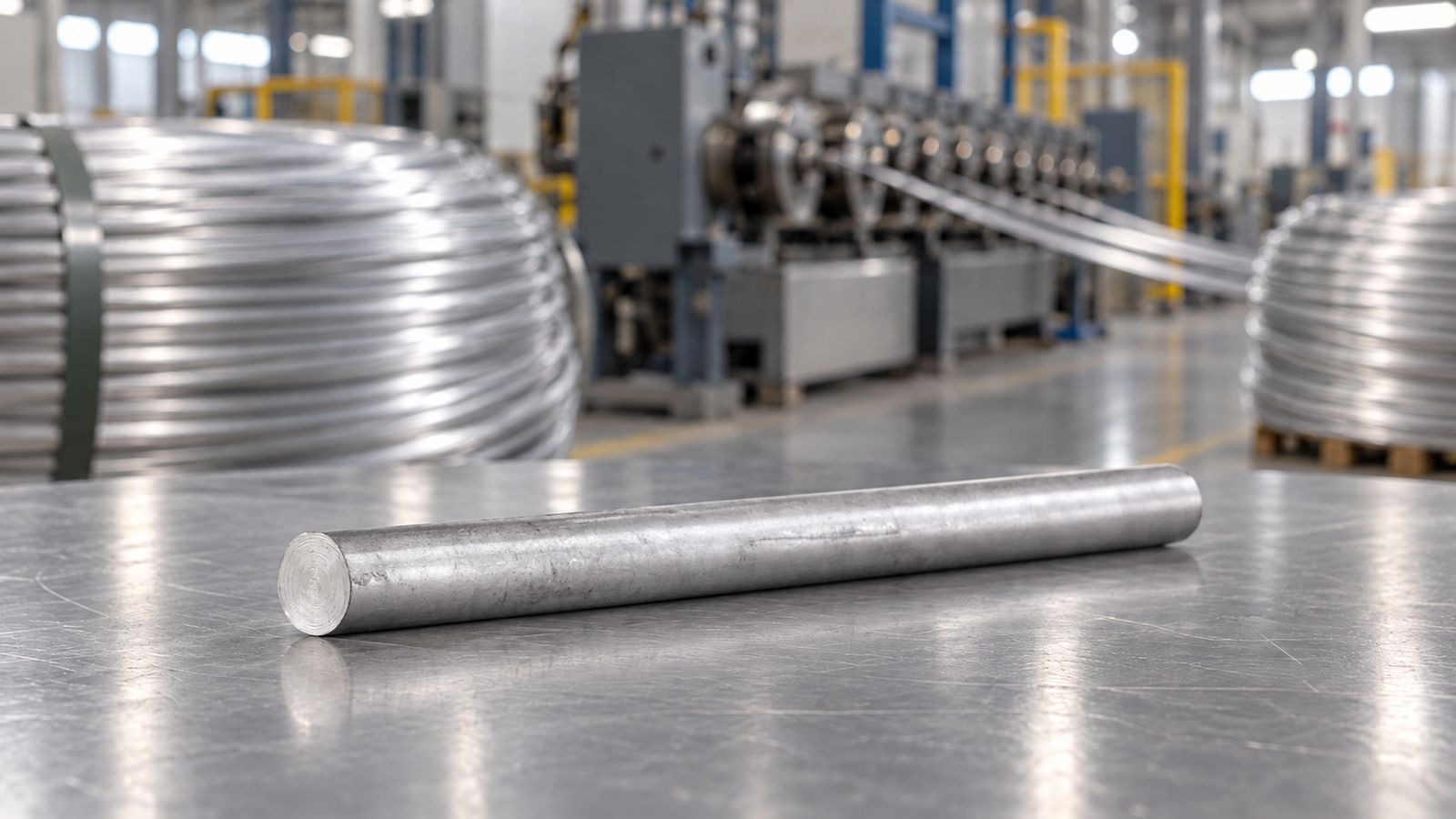
A conductor plant that buys the wrong rod grade finds out fast. The wire breaks on the drawing machine, the finished conductor fails its resistance test, or the strands fall short of the tensile value in the tender. Each of these problems traces back to one early decision: which aluminium wire rod grades to buy for which product. EC grade, AL-7, AL-59, 6201 and 8176 rods all look alike on a coil, yet each one suits a different conductor or cable.
This guide explains what separates these grades, where each one fits, and what buyers should check on a rod specification before they place an order. It uses the published specifications of the Prem Cables wire rod range.
Every aluminium conductor and aluminium cable starts as a wire rod. Manufacturers draw the rod through dies into fine wire, then strand or insulate that wire into the final product. The rod's chemistry and temper set the limits for everything that follows.
Two properties pull against each other. Pure aluminium conducts electricity very well but has modest strength. Adding small amounts of alloying elements raises strength, but it usually lowers conductivity. Each rod grade strikes a different balance between the two, and the right grade depends on what the finished product must do.
Prem Cables manufactures aluminium wire rods in high-purity EC grade and in alloy grades, including AL-7, AL-59, 6101, 6201 and 8176. The figures below come from the Prem Cables technical specifications.
EC stands for electrical conductor grade. These rods use high-purity aluminium and deliver the highest conductivity in the range.
The temper code tells you how hard the rod is. In the Prem range, the H19 temper gives a higher tensile band than H14. Buyers should match the temper to their wire drawing process and the final wire properties they need.
AL-7 is an alloy grade that trades a little conductivity for more strength.
AL-7 also appears as a conductor option in the Prem MVCC range, which shows how one rod grade can serve several finished products.
AL-59 rods feed AL59 alloy conductors, which utilities use for transmission and distribution lines.
The conductivity of the finished conductor depends on the full process, from casting to drawing and stranding. For conductor-level data, check the AL59 conductor specifications alongside the rod data.
6201 belongs to the aluminium-magnesium-silicon family. Prem Cables supplies it in T4 temper.
This grade gives the highest rod strength in the range. It forms the base for products such as AAAC conductors, which Prem Cables makes from 6201-T81 alloy for overhead lines that need strength and corrosion resistance.
8176 is an 8000 series alloy developed for electrical conductors. It keeps conductivity close to EC grade.
Its main value lies in conductivity with improved creep behaviour and handling, rather than raw strength.
Start from the finished product, not from the rod. The conductor or cable specification tells you which properties the wire must reach, and those properties point to a grade.
Choose EC grade when conductivity comes first. AAC conductors, the aluminium in ACSR, and insulated cables all rely on high conductivity. In ACSR, the steel core carries the mechanical load, so the aluminium strands can use EC grade.
Choose an alloy grade when the aluminium must carry load. All-aluminium alloy conductors have no steel core, so the alloy itself must provide the tensile strength. That points buyers to 6201, AL-59 or AL-7, depending on the conductor design and the utility specification.
Balance conductivity and strength for each project. Higher strength allows longer spans or lower sag in some designs, while higher conductivity lowers resistance and losses. No single grade wins on both counts, so engineers should weigh line length, span, load and environment. Coastal and industrial routes add one more factor, since alloy conductors without a steel core avoid the galvanic corrosion risk that steel-cored designs carry. Cost and availability matter too, so confirm lead times for alloy grades early in the project.
Follow the governing standard. The utility or conductor standard often fixes the alloy directly. For example, AAAC specifications commonly call for 6201 alloy wire, while AL59 conductor specifications call for AL-59 alloy.
Prem Cables lists three standards for its wire rod range:
Ask your supplier which standard applies to each grade in your order. A rod that meets one standard may not meet another, so the purchase order should name the exact reference.
Rod defects cause wire breaks during drawing and lower yield at the conductor plant. A short list of checks helps buyers avoid them.
Conductivity and tensile certificates. Request lot-wise test certificates that report conductivity and tensile strength against the agreed grade.
Diameter and tolerance. Prem Cables keeps rod diameters between 7.6 mm and 15 mm within ±0.5 mm, which supports smooth downstream drawing and extrusion. Confirm that the supplied diameter matches your drawing line.
Surface condition. Good rods come free from laps, kinks and seams. Prem Cables uses continuous casting and controlled rolling to achieve a smooth, defect-free surface and uniform mechanical properties.
Coil handling. Agree on coil weight, packing and marking so rods reach your plant without damage.
For a deeper look at these checks, read our guide to aluminium wire rod quality parameters that conductor manufacturers track.
Prem Cables lists four main application areas for its rods:
Prem Cables runs integrated production lines that take aluminium from rod to finished conductor and cable. That backward integration gives the company direct control over rod quality before the metal reaches its stranding and cable lines.
Prem Cables has manufactured aluminium conductors since 1964 at Pipalia Kalan in Rajasthan. Its integrated production lines run from rod to conductor and cable, under ISO 9001:2015 certified processes and with an in-house testing laboratory.
For conductors and cable makers, this matters. A rod supplier that also draws and strands its own wire understands how rod properties behave further down the line, and it can discuss grade choices in practical terms.
The right aluminium wire rod grade depends on the finished product. EC grade suits products that need maximum conductivity, while AL-7, AL-59, 6201 and 8176 alloys serve conductors that need more strength or specific performance. Buyers who start from the product specification, name the standard, and check certificates for conductivity, tensile strength and diameter avoid most rod-related problems.
Compare the full range of aluminium wire rod grades on the Prem Cables product page, then contact the Prem Cables team to discuss grades, diameters and documents for your next order.
Common grades include EC grade (1000 series) for high conductivity and alloy grades such as AL-7, AL-59, 6101, 6201 and 8176 for added strength or specific conductor designs.
EC grade means electrical conductor grade. It uses high-purity aluminium, and Prem Cables specifies a minimum conductivity of 61.4% IACS for its EC grade rods.
EC grade rods give higher conductivity, while alloy rods give higher tensile strength with somewhat lower conductivity.
AAAC conductors typically use 6201 alloy, and Prem Cables makes its AAAC from 6201-T81 aluminium alloy.
Prem Cables supplies aluminium wire rods in diameters from 7.6 mm to 15 mm, held within ±0.5 mm, depending on grade.
Prem Cables references IS 5484:2023 and ASTM B233 for aluminium wire rods, and IS 9997:2023 for aluminium alloy conductor wire.
Manufacturers draw aluminium wire rods into wire for AAC, ACSR, AAAC and other conductors, insulated cables, AB cables and transformer windings.
Ask for lot-wise certificates for conductivity and tensile strength, confirm diameter and tolerance, and check that rods are free from laps, kinks and seams.


