
.png)
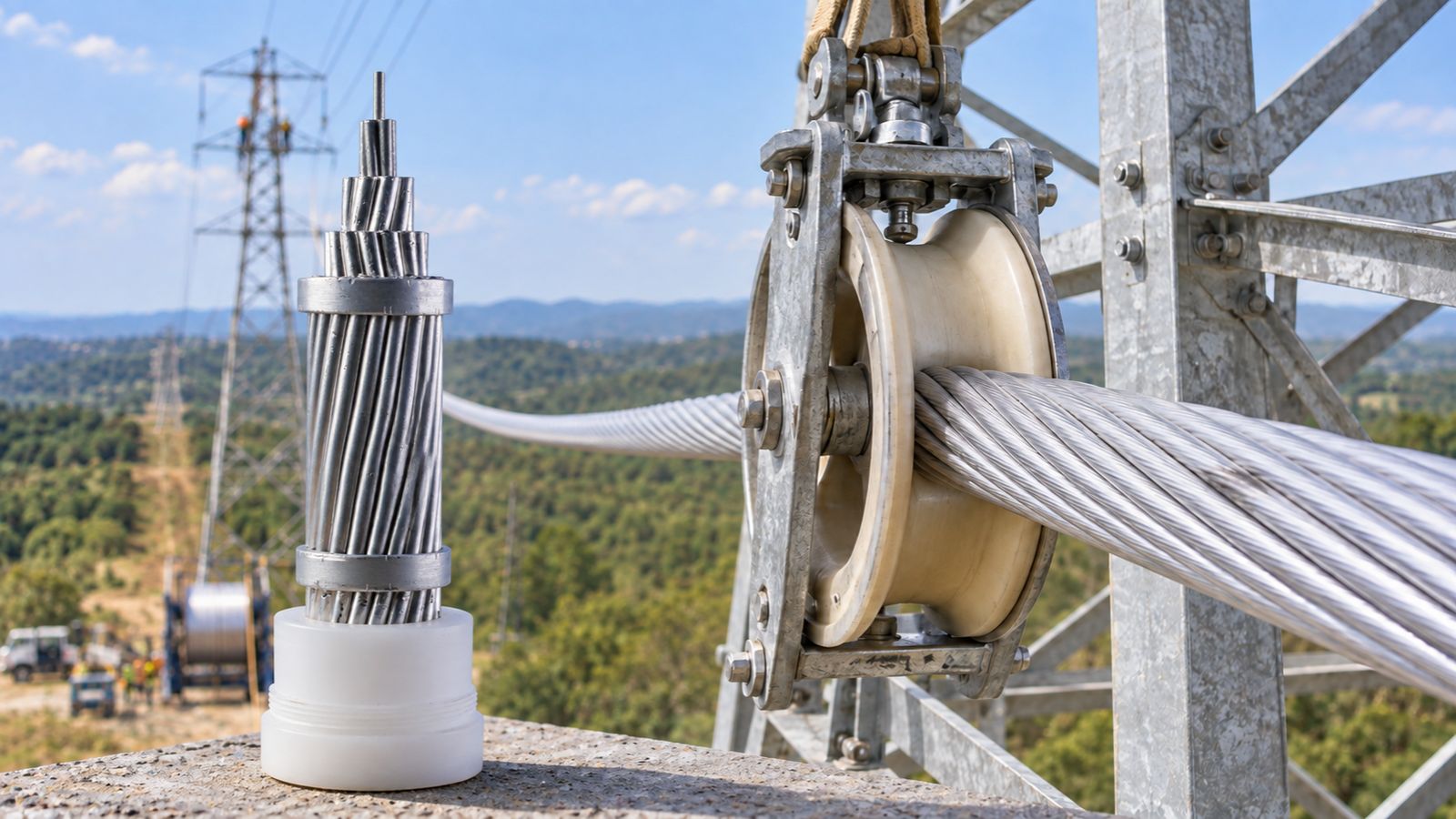
A conductor can pass every factory test and still reach service with damage picked up on site. Scuffed strands, a loose joint or a sag set at the wrong temperature can undo the value of a well-made conductor. AL59 conductor installation needs particular care because the conductor has no steel core, so every strand is an aluminium alloy wire that site crews must protect. This guide follows the job in order, from drum arrival to damper fitting.
Many line crews learned their craft on ACSR. In ACSR, a galvanised steel core takes much of the tension. In an AL59 conductor, the aluminium-magnesium-silicon alloy strands carry both the current and the mechanical load.
That changes a few habits on site. Grips, clamps and joints must suit an all-alloy conductor. Sag tables must reflect the alloy’s own stress-strain and creep behaviour. And because the outer strands also do structural work, surface damage matters more than it might on a steel-cored conductor.
The guidance below draws on general line construction practice, including the scope of IEEE Std 524, the IEEE guide for installing overhead transmission line conductors. Always follow your utility’s specification and the hardware maker’s instructions where they differ.
Good installation starts before a single metre leaves the drum.
Check each drum on arrival. Confirm the drum marking against the dispatch documents: conductor type, size, length and drum number. Look for broken battens, flange damage or signs that the drum was dropped. Record any damage before you accept delivery.
Store drums on firm, level, well-drained ground. Keep the battens in place until the drum goes to the stringing site. Roll drums only in the direction marked on the flange, so the conductor layers do not loosen. Avoid lifting with slings passed through the conductor layers; use a spindle through the drum centre instead.
Sag-tension tables built for ACSR will not suit AL59. Ask for the conductor’s mass, diameter, rated strength, modulus and thermal expansion data, then build tables for your spans and design temperatures. Prem Cables publishes mass, diameter, resistance and UTS for each size on its AL59 conductor specification page.
Plan for creep. Aluminium and aluminium alloy conductors lengthen slowly under sustained tension, so sag grows over the first years of service. Designers usually compensate by stringing to “initial” sags that are slightly tighter than the long-term “final” values. Your design team should state which method they used.
This is where many problems begin. Check every item that will grip the conductor:
Safety planning belongs in the stringing plan, not just the site induction. A conductor being strung near an energised line, or under an existing circuit, can pick up dangerous induced voltage. Static charge can also build up on long lengths of conductor during a pull.
IEEE Std 524 gives considerable attention to grounding during stringing, including earthing at the pulling and tensioning sites and at the stringing blocks. Before the pull starts, the crew should know:
This briefing costs little time and protects both the crew and the conductor.
Tension stringing keeps the conductor clear of the ground from the drum to the tower. A puller at one end draws a pilot rope, and a tensioner at the other end holds the conductor under controlled back-tension. This method limits contact with soil, rocks, fences and crops, which can scratch alloy strands.
Slack stringing, where crews lay the conductor on the ground and then lift it, raises the risk of surface damage. It may still suit short distribution spans, but transmission work generally favours tension methods.
Stringing blocks (travellers) guide the conductor over each tower during the pull. Use blocks with lined sheaves sized for the conductor. A sheave that is too small bends the conductor sharply and can disturb strand layers. Check that every block turns freely before the pull. A seized block drags the conductor and can damage the outer layer.
Set the stringing tension from the stringing plan and keep it steady. Sudden jerks, stops or tension swings can cause “bird-caging”, where the outer strands open up and loosen. Keep radio contact between the puller and tensioner crews at all times.
Use conductor grips designed for aluminium alloy conductors. Grips meant for steel strand can bite into alloy wires. Place grips only where the conductor will later be cut out, or where the maker confirms they leave no damage.
Measure the conductor temperature, not just the air temperature, when you set sag. A sunlit conductor can run warmer than the surrounding air. Read the correct sag from your table for that temperature and span.
Check sag on representative spans across each section, especially long and inclined spans. Then clip the conductor into suspension clamps without undue delay. A conductor left sitting in blocks can creep unevenly and shift between spans. IEEE Std 524 includes guidance on clipping offsets for inclined and uneven spans, and your design team should confirm whether offsets apply.
Joints are a common source of hot spots on overhead lines. A careful routine avoids most problems.
Most utility specifications also limit the number of mid-span joints and keep joints away from tension and suspension clamps. Follow those limits.
Steady winds can make overhead conductors vibrate at small amplitudes, known as aeolian vibration. Over time, this can fatigue strands near clamps. Install vibration dampers at the positions given by the damper supplier’s study. Fit them soon after clipping-in, so the new conductor does not sit unprotected through windy weather.
These errors appear often enough to deserve a checklist:
Walk or fly the line before energisation. Look for opened strands, grip marks, damaged joints and missing dampers. Confirm ground and crossing clearances against the design and the applicable CEA safety regulations. Record everything in the handover file, including drum numbers, so any later issue traces back to a specific length.
AL59 conductors are known for good corrosion resistance on coastal and industrial routes. That durability only pays off if the conductor goes up without damage. For a view of how the conductor is made before it reaches the site, read how AL59 alloy conductors are manufactured.
Successful AL59 conductor installation comes down to three habits: protect the strand surface, use data and hardware made for all-alloy conductors, and set sag with creep and temperature in mind. Crews who follow those habits give the line the best chance of reaching its design life.
Planning a project? Contact the Prem Cables team for AL59 technical data to support your sag-tension design and hardware selection. You can also compare related options on the AAAC conductor page.
Tension stringing is generally preferred for transmission lines. It keeps the conductor off the ground and limits surface damage to the alloy strands.
No. ACSR fittings often include a steel sleeve for the core. AL59 needs clamps and joints designed for all-aluminium alloy conductors.
AL59 has different weight, strength, stiffness and thermal behaviour from ACSR. Tables built for ACSR will give wrong sags and tensions.
Creep makes the conductor lengthen slowly under tension. Crews string to slightly tighter initial sags so the line reaches the correct final sag later.
It is better to use conductor temperature. A conductor in sunlight can run warmer than the air, which affects the correct sag reading.
Sudden changes in tension or speed, or sharp bends over small sheaves, can open the outer strands. Steady tension control helps prevent it.
Soon after clipping-in, at the positions set by the damper supplier. This protects new strands from aeolian vibration fatigue.
IEEE Std 524 gives general guidance on stringing methods, equipment and tools. Utility specifications and CEA regulations also apply in India.


