
.png)
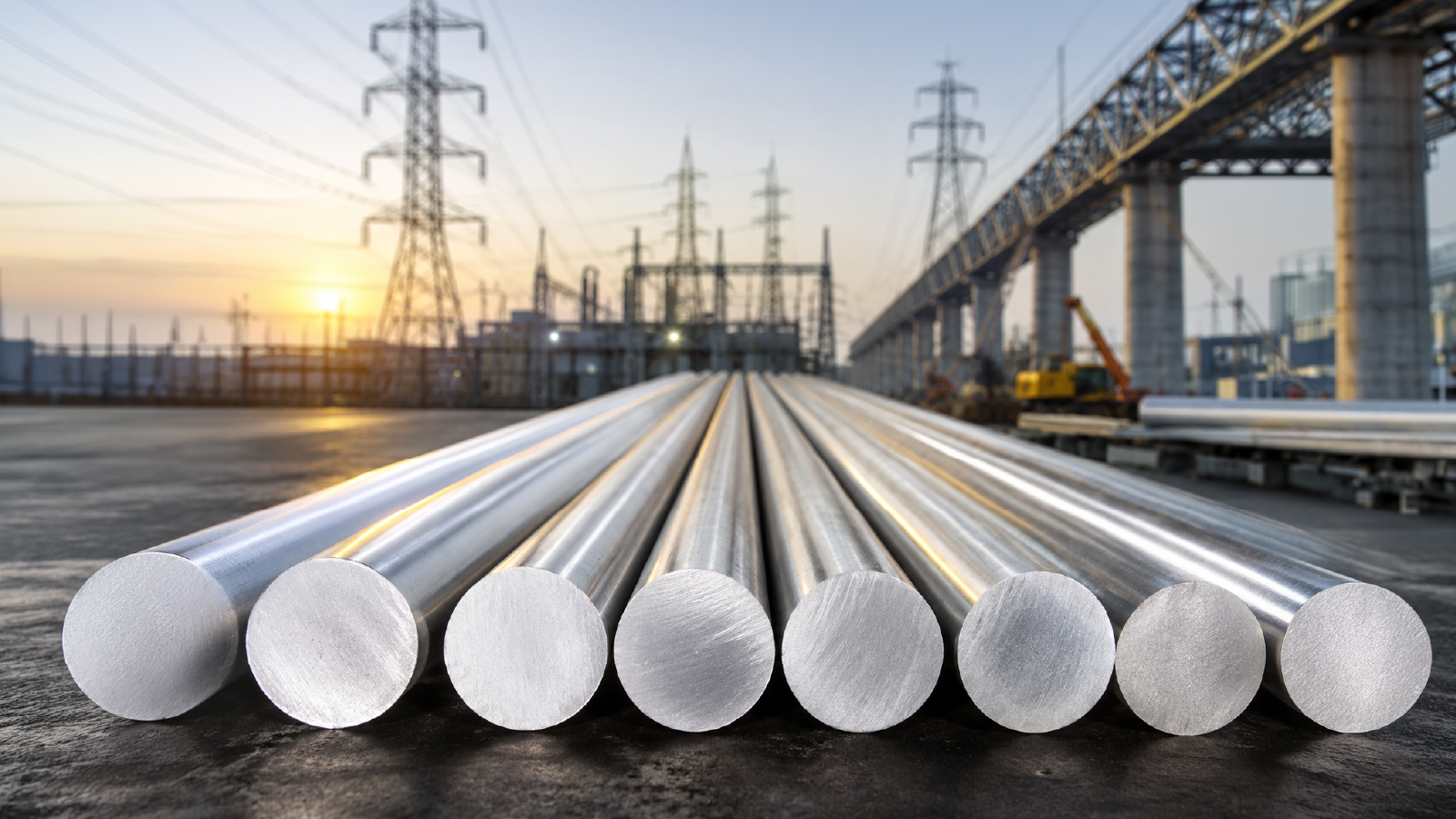
India's power sector is expanding at a pace few countries can match. New transmission corridors, rural electrification schemes, and smart grid upgrades demand materials that perform under heavy load and harsh weather. This is why 6XXX Series aluminium rods have become the standard raw material for conductors used across transmission and distribution networks.
Power transmission companies and electricity distribution utilities need conductors that combine strength with conductivity. A rod that bends easily or corrodes fast creates outages and costly replacements. 6XXX series rods solve this problem through a balanced alloy composition of aluminium, magnesium, and silicon, giving engineers a material that holds its shape under tension while carrying current efficiently.
This blog explains why these rods dominate India's infrastructure procurement lists, how they compare to older alloy grades, and what utilities should check before placing bulk orders.
Aluminium rods come in several series, each suited to different applications. The 6XXX series stands out because it is heat-treatable. Manufacturers subject the rods to controlled thermal processes that increase tensile strength without sacrificing conductivity.
Standard EC grade rods offer excellent conductivity but limited mechanical strength. Pure aluminium alone cannot withstand the tension load of long transmission spans. The 6XXX alloy group, including grades like 6101 and 6201, fills this gap. It delivers medium to high strength along with dependable current-carrying capacity, making it ideal for both overhead conductors and underground cable cores.
These rods also resist corrosion well. Coastal states such as Gujarat, Tamil Nadu, and Odisha run transmission lines close to saline air, and rods that corrode quickly shorten conductor life. The oxide layer that forms naturally on 6XXX series rods protects the metal underneath, extending service life even in demanding environments.
Transmission companies design lines to last decades. They cannot afford frequent conductor replacement across hundreds of kilometres of towers. 6XXX Series Aluminium Rods answer this need through a strength-to-weight ratio that few other alloys match.
A lighter conductor reduces the load on towers and insulators. This lowers the overall cost of a transmission project because engineers can use lighter support structures without compromising safety. At the same time, the added tensile strength allows longer spans between towers, which reduces the number of towers required and cuts project timelines.
Thermal stability is another reason these rods win approval from utility engineers. Transmission lines heat up under continuous load, especially during peak summer demand. Rods that soften or sag at high temperatures cause line clearance violations. 6XXX series alloys retain their mechanical properties across a wide temperature range, keeping sag within safe limits.
Distribution companies operate under different constraints than transmission utilities. Their networks run through dense urban areas, industrial zones, and rural feeders where installation speed and cost control matter as much as performance.
Aluminium conductor wire rods drawn from the 6XXX series suit distribution networks because they combine ease of installation with long-term reliability. Line crews can handle and string these conductors without specialised equipment, which speeds up project execution across large rollout areas.
Distribution feeders also face frequent load fluctuations from industrial machinery, agricultural pumps, and residential demand spikes. Rods with stable mechanical properties handle these fluctuations without fatigue cracking, a common failure mode in lower-grade conductors.
Grid reliability depends on conductors that perform consistently across seasons and load cycles. 6XXX-series aluminium rods bring several technical advantages that directly support this goal.
The rods maintain dimensional precision during manufacturing. Diameters stay within tight tolerances, which ensures uniform stranding when the rods are drawn into wires and formed into conductors. Uniform stranding reduces resistance losses and improves the overall efficiency of power transfer.
Manufacturing quality also plays a role in preventing line faults. Rods free from surface defects like laps, kinks, and seams reduce the risk of microcracks developing during stranding or field installation. Fewer defects mean fewer unplanned outages and lower maintenance costs over the life of the network.
Corrosion resistance rounds out the technical case. Utilities operating in industrial belts near Bhilai, Rourkela, or Vadodara deal with airborne pollutants that attack lesser alloys. The protective oxide layer on 6XXX series rods keeps conductivity stable even after years of exposure.
Procurement teams often compare upfront material cost across alloy grades. This approach misses the bigger picture. 6XXX Series aluminium rods reduce lifecycle costs through fewer replacements, lower maintenance visits, and reduced transmission losses.
Lighter conductors also reduce transportation and installation expenses. Projects that span remote or hilly terrain benefit significantly, since lighter reels are easier to transport and string across difficult access points.
Energy loss during transmission is a direct cost to utilities and, ultimately, to consumers. Conductors made from properly manufactured 6XXX rods maintain conductivity levels that keep transmission losses within acceptable limits, supporting the efficiency targets set by state and central regulators.
Utilities cannot use conductor material that fails to meet regulatory benchmarks. 6XXX Series aluminium rods manufactured to IS 5484:2023 and IS 9997:2023 meet the specifications set for Indian power infrastructure projects. These standards define permissible tolerances for diameter, tensile strength, and conductivity, giving procurement teams a clear benchmark for quality checks.
International standards such as ASTM B233 further validate the material for projects that require cross-border equipment compatibility or export documentation. Compliance with recognised standards reduces approval delays during tendering and audit processes, which matters for state electricity boards working under tight project deadlines.
Material specification alone does not guarantee performance. The manufacturing process, quality control systems, and testing protocols followed by the supplier determine whether rods perform as expected in the field.
Utilities should request test certificates for conductivity, tensile strength, and dimensional accuracy before accepting bulk shipments. Suppliers who invest in continuous casting and controlled rolling produce rods with fewer defects and more consistent mechanical properties batch after batch.
Prem Cables manufactures 6XXX series and other alloy-grade wire rods that meet these quality benchmarks, supplying the base material used in conductors for transmission and distribution projects across India. Buyers evaluating suppliers should also check the finished conductor range built on these rods, including ACSR and AAAC conductors, to confirm that the rod quality translates into reliable field performance.
India plans to add significant transmission capacity over the coming decade to support renewable energy integration and industrial growth. This expansion increases demand for conductor materials that balance performance with cost.
6XXX Series Aluminium Rods are positioned to meet this demand because they scale well across project types, from high-voltage transmission lines to last-mile distribution feeders. Utilities that standardise on this alloy group benefit from simplified procurement, consistent field performance, and lower total cost of ownership across their networks.
Engineers and procurement teams researching conductor materials can also review related resources on the Prem Cables blog for deeper technical comparisons between alloy grades and conductor types.
Power transmission and distribution companies across India are moving away from conventional aluminium grades toward 6XXX Series aluminium rods because these rods deliver the strength, conductivity, and durability that modern grids require. From coastal corrosion resistance to high temperature stability, the technical advantages translate directly into fewer outages, lower maintenance costs, and longer network life. Utilities planning new projects or upgrading existing lines should prioritise this alloy group and verify supplier quality standards before finalising procurement decisions.
What are 6XXX Series Aluminium Rods used for in power projects?
These rods serve as the base material for ACSR, AAAC, and AAC conductors used in transmission and distribution lines. Manufacturers also use them for transformer windings and aerial bundled cables. Their combination of strength and conductivity makes them suitable for both overhead and underground applications across urban and rural grids.
How do 6XXX series rods compare to EC grade aluminium rods?
EC grade rods offer higher conductivity but lower mechanical strength. 6XXX series rods trade a small amount of conductivity for significantly higher tensile strength through heat treatment. This makes them better suited to long transmission spans where sag control and load-bearing capacity matter more than marginal conductivity gains.
Are 6XXX-series aluminium rods corrosion resistant?
Yes. These rods form a natural oxide layer that protects the metal from moisture, industrial pollutants, and coastal salinity. This property extends conductor life significantly in regions with harsh environmental conditions, reducing replacement frequency for utilities.
What standards apply to aluminium conductor wire rods in India?
Indian manufacturers follow IS 5484:2023 for wire rod specifications and IS 9997:2023 for alloy conductor wire and stranded wire. International projects may also reference ASTM B233. These standards define tolerances for diameter, tensile strength, and conductivity that suppliers must meet.
Why do distribution companies prefer this alloy over other options?
Distribution networks need conductors that install quickly and handle frequent load changes without fatigue failure. 6XXX series rods offer that stability along with a lighter weight profile, which reduces installation costs and supports faster project rollout across urban and rural feeders.


