
.png)
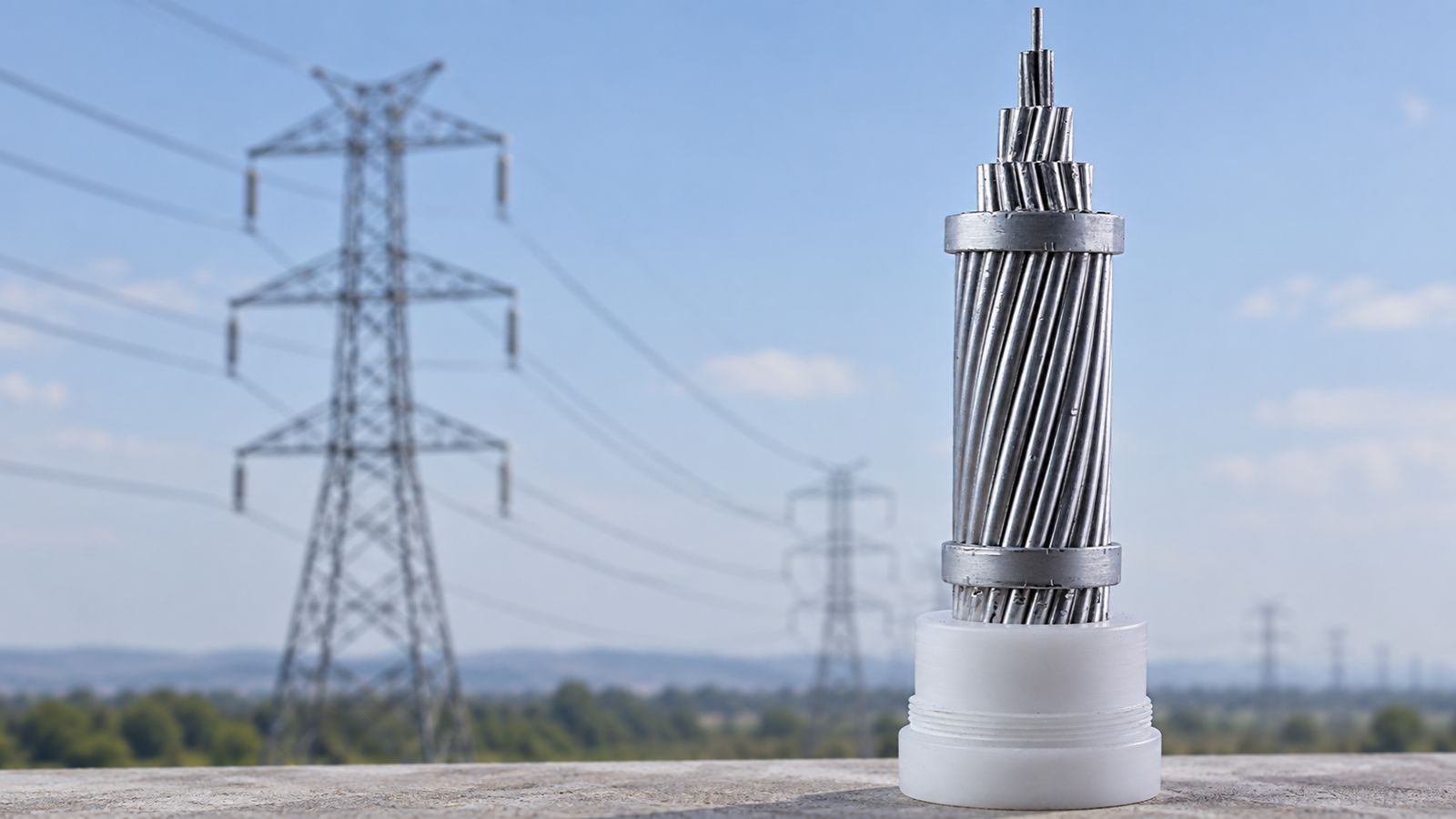
Every transmission tower carries the weight of its conductors, the push of the wind and the pull of line tension. When a utility swaps a steel-reinforced conductor for an AL59 conductor, one question comes up fast: will the towers carry less load? The honest answer is “often, in the vertical direction”, but the full picture depends on span, tension, sag and wind. This article works through those factors using published conductor data, so design and procurement teams can judge the benefit for their own line.
Engineers usually break tower loading into three directions. Each one responds differently to a conductor change.
A lighter conductor mainly changes the vertical component. It can also change tension and sag, which then feed into the other two directions. That is why a simple “lighter means better” claim does not hold on its own.
AL59 is a high-conductivity aluminium-magnesium-silicon (Al-Mg-Si) alloy. The name refers to its typical conductivity of about 59% IACS, according to the Prem Cables AL59 conductor. Every strand in the conductor is aluminium alloy. There is no steel core.
That construction matters for tower loads. Steel is roughly three times denser than aluminium, so removing the steel core cuts weight. The alloy strands then carry the mechanical load that the steel core would otherwise take.
In India, the Central Electricity Authority (CEA) identifies AL59 as a high-conductivity aluminium alloy conductor as per IS 398 Part 6. The CEA Manual on Transmission Planning Criteria 2023 also lists AL59 constructions as equivalents for common ACSR sizes such as Zebra, Moose and Panther.
Suspension towers mostly hold the weight of the conductor across the “weight span”, the length of conductor each tower effectively supports. Cut the conductor mass per kilometre and the vertical load per tower falls in proportion, before adding insulators and fittings.
Scale this to a full line. A 400 kV double-circuit line with twin sub-conductors has 12 phase conductors. With the figures above, AL59 would carry about 4.4 tonnes less conductor weight per route kilometre than ACSR Moose. This is a simple illustration, not a design figure, but it shows why the difference matters on long lines.
Dead-end and angle towers resist conductor tension. Designers set stringing tension as a share of the conductor’s rated strength. Because AL59 has a lower breaking load than Moose, its allowable tension will usually be lower too. Lower tension can reduce longitudinal and angle loads, but it also affects sag, which brings us to the trade-off.
Sag depends on the weight per unit length, the horizontal tension and the conductor’s thermal expansion. A lighter conductor at the same tension sags less. At a lower tension, it may sag about the same or more.
Thermal behaviour also counts. An all-alloy conductor has no steel core to limit expansion, so it can elongate more as it heats. Designers must check sag at the maximum operating temperature, not just at stringing temperature. Where sag stays within limits, the saving in weight can support longer spans or lower tower heights. Where it does not, the benefit shrinks.
The weight advantage tends to matter most in a few situations.
The electrical side supports the case as well. In the comparison above, AL59 shows about 10% lower DC resistance and about 7% higher ampacity at the CEA reference conditions. So the lighter conductor also carries more current in this example.
AL59 is not a universal answer to tower loading. Keep these limits in view:
A proper sag-tension study and tower check should confirm the benefit for each line. The conductor choice feeds that study; it does not replace it.
Many conductor comparisons stop at weight per kilometre. That gives only part of the answer. A useful study for tower loading looks at the following, on the same basis for every candidate conductor:
When all six points line up in favour of a lighter conductor, the case for reduced tower load becomes strong. When one or two point the other way, the design team can decide with clear numbers rather than assumptions.
An AL59 conductor can reduce the vertical load on transmission towers because it removes the heavy steel core while keeping a similar diameter. It can also improve ampacity and lower resistance. However, its lower breaking strength and thermal behaviour mean the effect on longitudinal loads, sag and span length depends on each line’s design conditions.
The best approach is to compare candidate conductors on the same basis: mass, diameter, breaking load, resistance and ampacity at your design ambient temperature. Prem Cables publishes full AL59 size tables, from 15 mm² up to 774 mm², to support that comparison. You can also review the related ACSR conductor specifications side by side.
If you are planning a new line or a reconductoring project, share your line parameters with the Prem Cables team to discuss suitable AL59 sizes and supporting technical data.
An AL59 conductor is an all-aluminium alloy conductor made from Al-Mg-Si alloy with a typical conductivity of about 59% IACS. It has no steel core.
It can reduce vertical load because it weighs less than a similar ACSR size. The effect on tension, sag and wind load depends on line design.
Based on published data, the AL59 61/3.52 conductor weighs about 1,638 kg/km, against about 2,004 kg/km for ACSR Moose, or roughly 18% less.
No. In the Moose-size comparison, AL59 has a lower breaking load (about 135 kN versus 161 kN). Its strength-to-weight ratio is only slightly higher.
Often, yes, subject to a structural and sag-tension check. Its similar diameter and lower weight can fit within existing tower margins.
The CEA refers to AL59 as a high-conductivity aluminium alloy conductor as per IS 398 Part 6.
Not always. Sag depends on weight, tension and thermal expansion. A lighter conductor strung at lower tension may sag as much as a heavier one.
Prem Cables publishes AL59 size tables covering area, stranding, diameter, mass, resistance and UTS on its AL59 conductor page.


